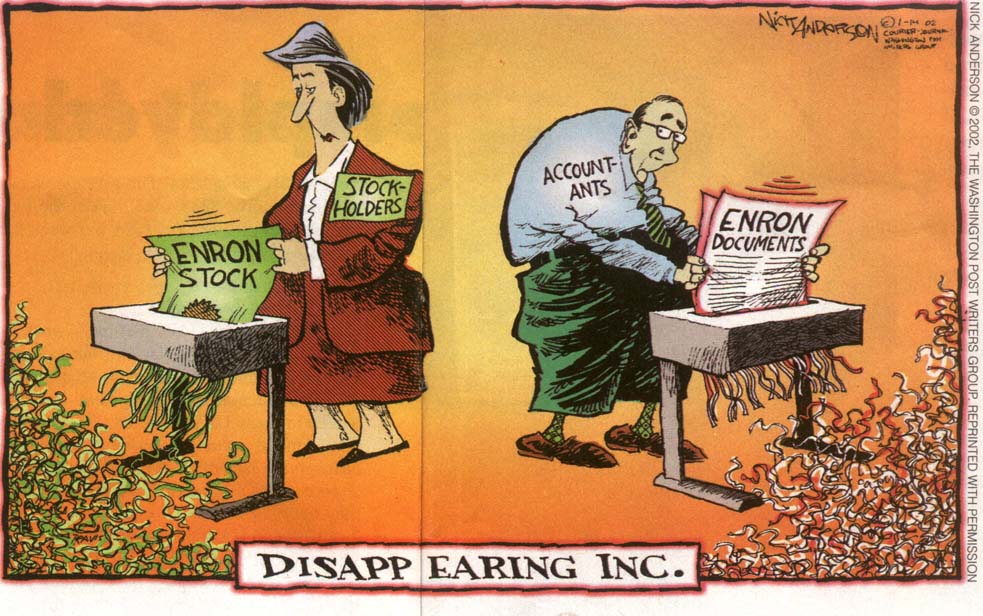
Everyone knows at least a little about the Enron story and the devastation it
created in the lives of is employees. When accounting ethics and standards are
discarded for personal greed, it's a story that belongs in any discussion of
ethical accounting processes and what happens.
With this change, Enron began to function more as a middleman than a
traditional energy supplier, trading in energy contracts instead of buying and
selling natural gas. Enron's rapid growth created excitement among investors
and drove the stock price up.
One partnership created by Enron, Chewco Investments (named after the Star Wars
character Chewbacca) allowed Enron to keep $600 million in debt off of the
books it showed to the government and to people who own Enron stock. When this
debt did not show up in Enron's reports, it made Enron seem much more
successful than it actually was.
In August 2001, Enron vice president Sherron Watkins sent an anonymous letter
to the CEO of Enron, Kenneth Lay, describing accounting methods that she felt
could lead Enron to "implode in a wave of accounting scandals." In
August, CEO Kenneth Lay sent e-mails to his employees saying that he expected
Enron stock prices to go up. He sold off his own stock in Enron.
On October 22nd, the Securities and Exchange Commission (SEC) announced that
Enron was under investigation. On November 8th, Enron said that it has
overstated earnings for the past four years by $586 million and that it owed
over $6 billion in debt by next year.
With these announcements, Enron's stock price took a dive. This drop triggered
certain agreements with investors that made it necessary for Enron to repay
their money immediately. When Enron could not come up with the cash to repay
its creditors, it declared for Chapter 11 bankruptcy.
With this change, Enron began to function more as a middleman than a traditional energy supplier, trading in energy contracts instead of buying and selling natural gas. Because this debt would make their earnings look less impressive, Enron began to create partnerships that would allow it to keep debt off of its books. One partnership created by Enron, Chewco Investments (named after the Star Wars character Chewbacca) allowed Enron to keep $600 million in debt off of the books it showed to the government and to people who own Enron stock. When this debt did not show up in Enron's reports, it made Enron seem much more successful than it actually was.
With this change, Enron began to function more as a middleman than a traditional energy supplier, trading in energy contracts instead of buying and selling natural gas. Because this debt would make their earnings look less impressive, Enron began to create partnerships that would allow it to keep debt off of its books. One partnership created by Enron, Chewco Investments (named after the Star Wars character Chewbacca) allowed Enron to keep $600 million in debt off of the books it showed to the government and to people who own Enron stock. When this debt did not show up in Enron's reports, it made Enron seem much more successful than it actually was.

Tidak ada komentar:
Posting Komentar